
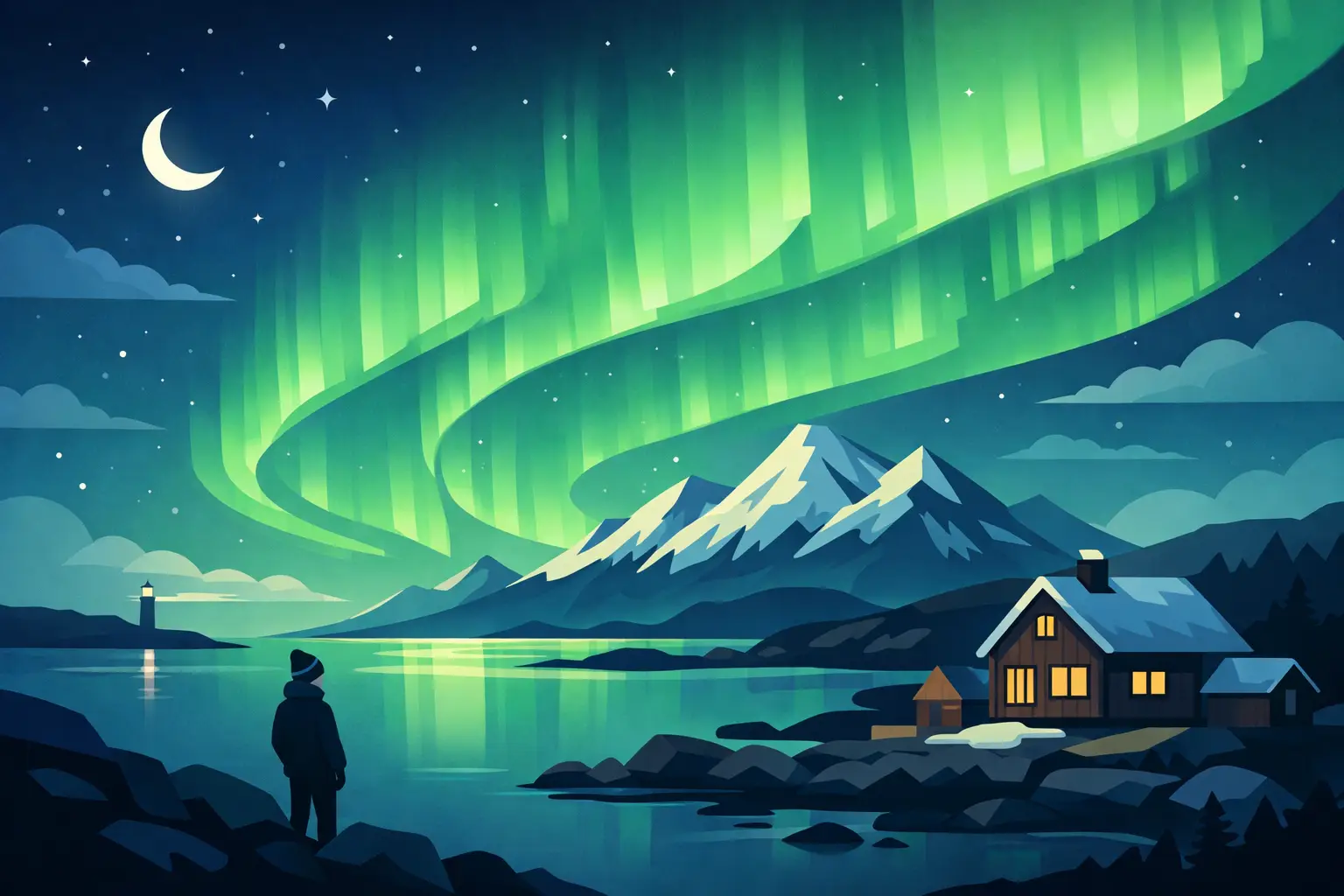
Northern Lights Forecast Iceland Tonight
Check the northern lights forecast Iceland tonight with smart timing, cloud tips, and the best places to improve your chances of seeing aurora.
If you are checking the northern lights forecast Iceland tonight, you probably do not need a science lecture. You need to know whether it is worth staying up, driving out, or booking a tour. The short answer is this: a good aurora night in Iceland depends on three moving parts at once - solar activity, cloud cover, and darkness. If even one of them is off, your odds drop fast.
That is why travelers sometimes see a weak forecast turn into a memorable display, while a promising aurora prediction produces nothing but low clouds and frustration. In Iceland, the forecast matters, but how you use it matters just as much.
How to read the northern lights forecast Iceland tonight
Most travelers focus on the aurora number first. That makes sense, but it is only part of the picture. A stronger aurora forecast usually means brighter, more active lights, yet you still need clear skies above your location. A high activity level over solid cloud cover is basically invisible.
Think of tonight's forecast as a two-part test. First, is there enough solar activity to create visible aurora? Second, where in Iceland will the sky actually open up? The best nights are not always the nights with the highest numbers. Often, they are the nights when moderate activity lines up with a few clear hours in the right region.
Darkness matters too. In peak winter, you get long hours of dark sky, which gives you more flexibility. In September and April, the nights are shorter, so timing gets tighter. Around midsummer, there is simply too much daylight for northern lights viewing, no matter what the solar forecast says.
What forecast numbers actually mean
Aurora forecasts often use a scale that estimates geomagnetic activity. Higher numbers can mean stronger displays and a better chance of seeing movement, shape, and color. But this is where expectations can go sideways.
A lower reading does not automatically mean "don't bother." In Iceland, even modest activity can still produce visible green arcs or soft bands if you are in a dark place with clear skies. On the other hand, a high reading can raise expectations so much that travelers expect the whole sky to explode for hours. Sometimes that happens. More often, aurora comes in pulses - ten good minutes, then a lull, then another burst.
If you are deciding whether to go out tonight, treat the activity number as a confidence signal, not a guarantee. A medium forecast with clear skies is often more useful than a strong forecast buried under cloud.
Cloud cover decides more nights than solar activity
This is the part many first-time visitors underestimate. Icelandic weather changes fast, and local cloud patterns can be surprisingly different within the same region. Reykjavik may be overcast while the South Coast has a window of clear sky, or the opposite.
That is why the best northern lights strategy is not just checking one national forecast and hoping for the best. It is matching aurora potential with the clearest reachable area. If you have a rental car, this gives you options. If you are based in Reykjavik without a car, a guided tour can make more sense because drivers actively chase the clearest conditions.
There is a trade-off here. Self-driving gives you flexibility and privacy, especially if you want to combine the evening with dinner, a hot spring, or photography stops. A tour saves stress, removes the night-driving issue, and usually builds the route around live weather and cloud updates. For many visitors in winter, that convenience is worth it.
Best places to go if the forecast looks promising tonight
Where you should go depends on where you are starting and how much driving you are comfortable with. If you are in Reykjavik, your first job is getting away from city light pollution. You do not always need a huge road trip. Sometimes a short drive to darker surroundings is enough if skies are clear.
Thingvellir is a classic option because it is relatively accessible from the capital area and has broad open views. The Reykjanes Peninsula can work well too, especially if cloud breaks are moving through the southwest. If you are already on the South Coast, the area around Vik, Skogafoss, or even farther east can be excellent when skies cooperate. In North Iceland, spots around Akureyri can produce strong sightings, though conditions still vary night to night.
The real rule is simple: prioritize clear sky over famous scenery. The perfect waterfall foreground means very little if the entire sky is closed in.
When to go out and how long to wait
Travelers often ask for the best exact time. The honest answer is that aurora does not run on a tidy schedule. Activity can flare early in the evening or after midnight. Still, the most productive window is usually from late evening into the middle of the night, when the sky is darkest.
If the forecast is decent tonight, do not make the mistake of checking once at 9 p.m., seeing nothing, and giving up. Northern lights can appear suddenly after long quiet stretches. Give yourself time. A two- to three-hour window is far more realistic than a quick look from the hotel parking lot.
Patience is especially important on partly cloudy nights. Openings come and go, and some of the best sightings happen in brief clear gaps. If conditions are improving, staying out a little longer can make the difference.
What can ruin your chances even on a good forecast
A promising forecast does not help much if you are standing under streetlights, looking through a bright hotel window, or checking the sky every five minutes from downtown. Light pollution weakens contrast, and your eyes need time to adjust to darkness.
Phone expectations can also be misleading. Cameras sometimes pick up more green than your eyes see at first, especially during weaker displays. That does not mean the aurora is fake. It means your camera sensor and your eyes respond differently in low light. On stronger nights, you may see structure and movement clearly. On weaker nights, the lights can start as a pale haze and become more obvious only after a few minutes of watching.
Weather is another issue. Wind, icy roads, and blowing snow can turn an optimistic aurora mission into a bad driving decision. If road conditions are poor, this is where booking a professionally operated outing becomes the safer call. A night of aurora chasing should feel exciting, not reckless.
Should you book a tour tonight or go on your own?
It depends on your trip style. If you have a car, are confident driving in Iceland at night, and do not mind adapting your plan last minute, self-driving can work extremely well. It gives you the freedom to pivot toward clearer skies and stay as long as you want.
If you are short on time, unfamiliar with winter roads, or simply want someone else to handle the forecast logic, a tour is often the better value. Good operators monitor conditions in real time and adjust departure areas and routes accordingly. That is especially useful if tonight is your only realistic aurora window.
For travelers using GoIce Travel to plan their Iceland trip, this is where having real-time tools and bookable options in one place becomes practical, not just convenient. You can check conditions, compare experiences, and make a fast decision before the weather shifts again.
Quick reality check for tonight's forecast
If tonight shows moderate to strong aurora activity, low to partial cloud cover where you are, and full darkness during your available hours, it is worth going. If activity is weak but skies are very clear, it may still be worth trying if you are nearby and flexible. If clouds are thick across your entire area, the forecast number matters less than you want it to.
The smartest travelers in Iceland do not chase the highest aurora score. They chase the best overlap of darkness, clear sky, and timing. That is usually what turns a forecast into an actual sighting.
If tonight is not your night, do not treat it as failure. Aurora viewing in Iceland is part timing, part weather, part luck. But when the sky opens and the first green band starts moving over black lava fields or snowy mountains, every delayed bedtime suddenly feels like a very good decision.