
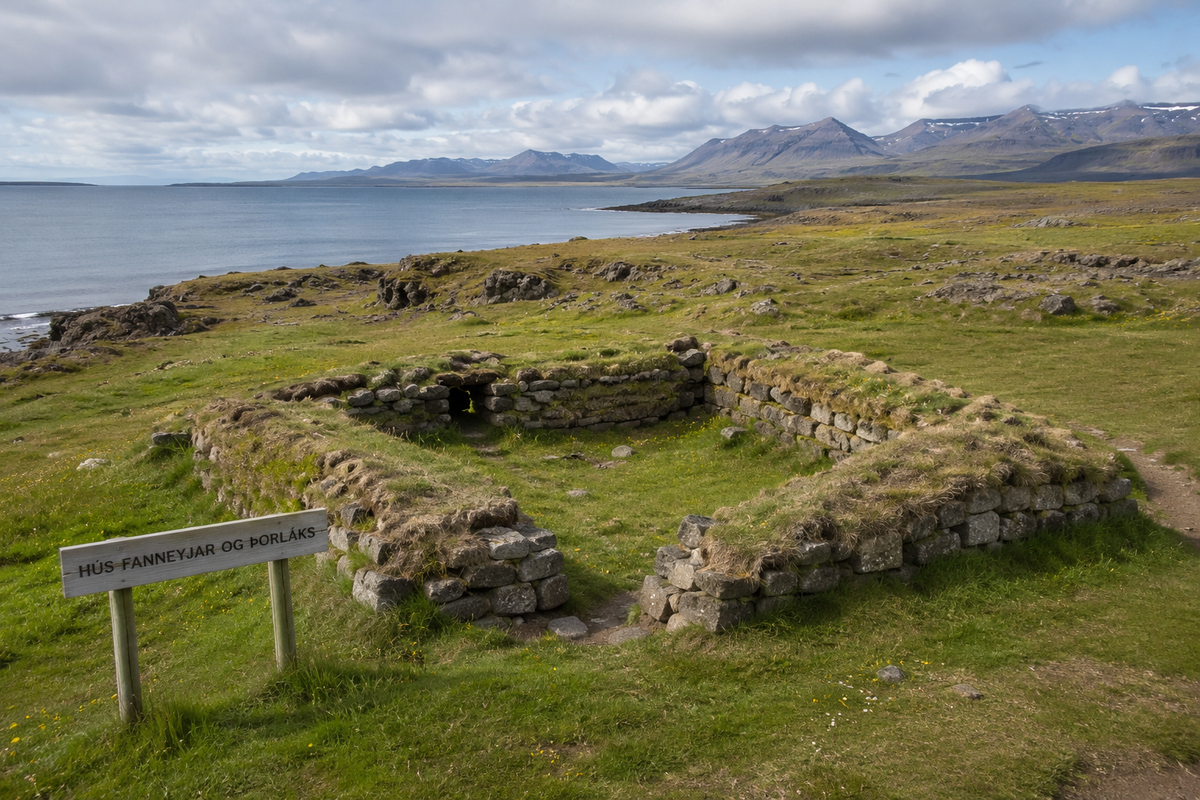
Hús Fanneyjar og Þorláks
Step back in time at this beautifully preserved 19th-century turf farm, a window into Icelandic rural life.
Stuttlega
Heimsóknartími
1–1.5小时
Besta árstíð
夏季,上午/下午
Leiðarvísir
铺设道路,可乘汽车到达
GPS
66.3289, -14.7627
Um
Um Hús Fanneyjar og Þorláks
Step back in time at this beautifully preserved 19th-century turf farm, a window into Icelandic rural life.
Ferðir nálægt Hús Fanneyjar og Þorláks
Diamond Circle Day Tour from Akureyri or Lake Myvatn
Imagine Iceland Travel · 9 hours
Lake Mývatn Shore Excursion from Akureyri Port - Spanish
Iceland Horizon - Saga Travel - GeoIceland · 6 hours
Private Northern Lights & GeoSea Geothermal Baths Tour (from Akureyri)
Imagine Iceland Travel · 5 hours
Private Combo Day: Lake Myvatn, Dettifoss, Selfoss and Godafoss Waterfalls Tour
Imagine Iceland Travel · 9 hours
Myndir
Myndavefur
Bakgrunnur
Saga og bakgrunnur
The history of Hús Fanneyjar og Þorláks is intrinsically linked to the broader tradition of Icelandic turf house construction, a building style perfected over centuries to cope with the island's harsh climate and scarcity of timber. Turf houses, or torfbæir, utilize abundant local materials – stone for foundations, timber for internal frames, and thick layers of turf for walls and roofs – creating remarkably well-insulated and sustainable dwellings. Laufás itself has a long and distinguished history, serving as an important parsonage and farm for centuries. While the current structures largely date from the 19th century, the site has been continuously inhabited since the settlement era. The farmstead specifically known as Hús Fanneyjar og Þorláks represents a typical, albeit larger, example of an Icelandic rural farm from that period. It provides invaluable insight into the socio-economic conditions and daily lives of the Icelandic populace before the significant changes brought about by the 20th century. The preservation of Laufás, and specifically this unit, was crucial for safeguarding a tangible link to Iceland's agricultural past and its unique architectural heritage. It stands today as one of the best-preserved and most accessible turf house complexes in the country, a living museum telling the story of generations who carved out a life in the challenging northern environment.
Hús Fanneyjar og Þorláks, part of the Laufás Museum, stands as a magnificent testament to Iceland's unique architectural heritage and rural history. This beautifully preserved 19th-century turf farm complex, located in North Iceland near Eyjafjörður, offers an unparalleled opportunity to step directly into the past. The farmstead comprises several interconnected turf-roofed buildings, including the baðstofa (communal living and sleeping quarters), kitchen, pantry, and workshop, all constructed from local stone, timber, and thick layers of turf. Visitors can wander through the dimly lit rooms, envisioning the daily routines of the farmers and their families who once inhabited these spaces. The interiors are furnished with authentic period pieces, from simple wooden beds and spinning wheels to cooking utensils and tools, providing a tangible sense of the challenges and rhythms of life in 19th-century Iceland. The names Fanney and Þorlákur refer to the last residents of this particular farm unit, adding a personal touch to its history. Beyond the main farm, the museum grounds often include a charming church and offer stunning views of the surrounding landscape. A visit here is not merely a walk through a building but an immersive cultural journey, revealing the ingenuity and resilience required to thrive in such an environment. It’s a profound experience for anyone interested in history, architecture, or the unique spirit of the Icelandic people.
Þjóðsögur
Saga og þjóðsögur
The wind, a constant companion, whispers tales through the turf walls of Hús Fanneyjar og Þorláks. Imagine Fanney, her hands calloused from years of tending to the sheep and preparing meals over an open fire, the scent of dried fish and peat smoke always lingering. Þorlákur, perhaps mending tools in the dimly lit workshop, the rhythm of his hammer echoing softly. Each room, from the communal living space (baðstofa) where families slept and worked, to the cramped pantry, tells a story of survival and community. Life here was hard, dictated by the seasons and the unforgiving Icelandic landscape. Yet, within these humble, earthy walls, generations found warmth, solace, and a profound connection to the land. This isn't just a museum; it's a living echo of a bygone era, where every creak of the timber and every patch of turf holds a memory.
Staðbundin þjóðsaga
劳法斯隐藏民族的低语
当地人低语说,劳法斯古老的草皮墙有时会受到 huldufólk,即隐藏民族的拜访。他们说,如果在寂静的夜晚仔细聆听,你可能会从空荡荡的房间里听到微弱的音乐或轻柔的说话声,预示着“好人”正在经过。
Staðsetning
Staðsetning
Discover
Explore Nearby
Places within 5.0 km
Loading nearby places…
0 places found within 5.0 km
Plan full itinerary →Kanna meira