Sankti Jósefskirkja
Modern architecture meets spiritual serenity at Hafnarfjörður's beautiful St. Joseph's Church.
About
About Sankti Jósefskirkja
Modern architecture meets spiritual serenity at Hafnarfjörður's beautiful St. Joseph's Church.
Experience modern Icelandic church architecture and a tranquil spiritual haven in Hafnarfjörður.
Photos
Photo Gallery
Background
History & Background
The origins of Catholic presence in Hafnarfjörður trace back to 1925, when the Sisters of St. Joseph erected a hospital alongside a chapel. This chapel was blessed on September 5, 1926, by the Apostolic Leader Marteinn Meulenberg SMM, and quickly became the parish church for the newly established St. Joseph’s Parish in Hafnarfjörður, serving the spiritual needs of the local community for decades. However, by 1987-1988, the Sisters of St. Joseph found it necessary to sell both the hospital and the original chapel. This decision prompted the need for a new church building to continue the parish's mission. Reverend Hjalti Þorkelsson, the parish priest in Hafnarfjörður, oversaw the construction of a new church, complete with an attached rectory and a parish hall, situated in Jófríðarstaðir. The new Sankti Jósefskirkja was designed by architect Knútur Jeppesen, bringing a modern aesthetic to its spiritual purpose. On July 3, 1993, Bishop Alfreð Jolson consecrated the new St. Joseph’s Church, marking a significant milestone for the Catholic community in Iceland. Further enhancing its interior, "Stations of the Cross" artworks by the Swiss artist Bradi Barth were installed on the church walls in 1997, adding a profound artistic and devotional element to the sacred space.
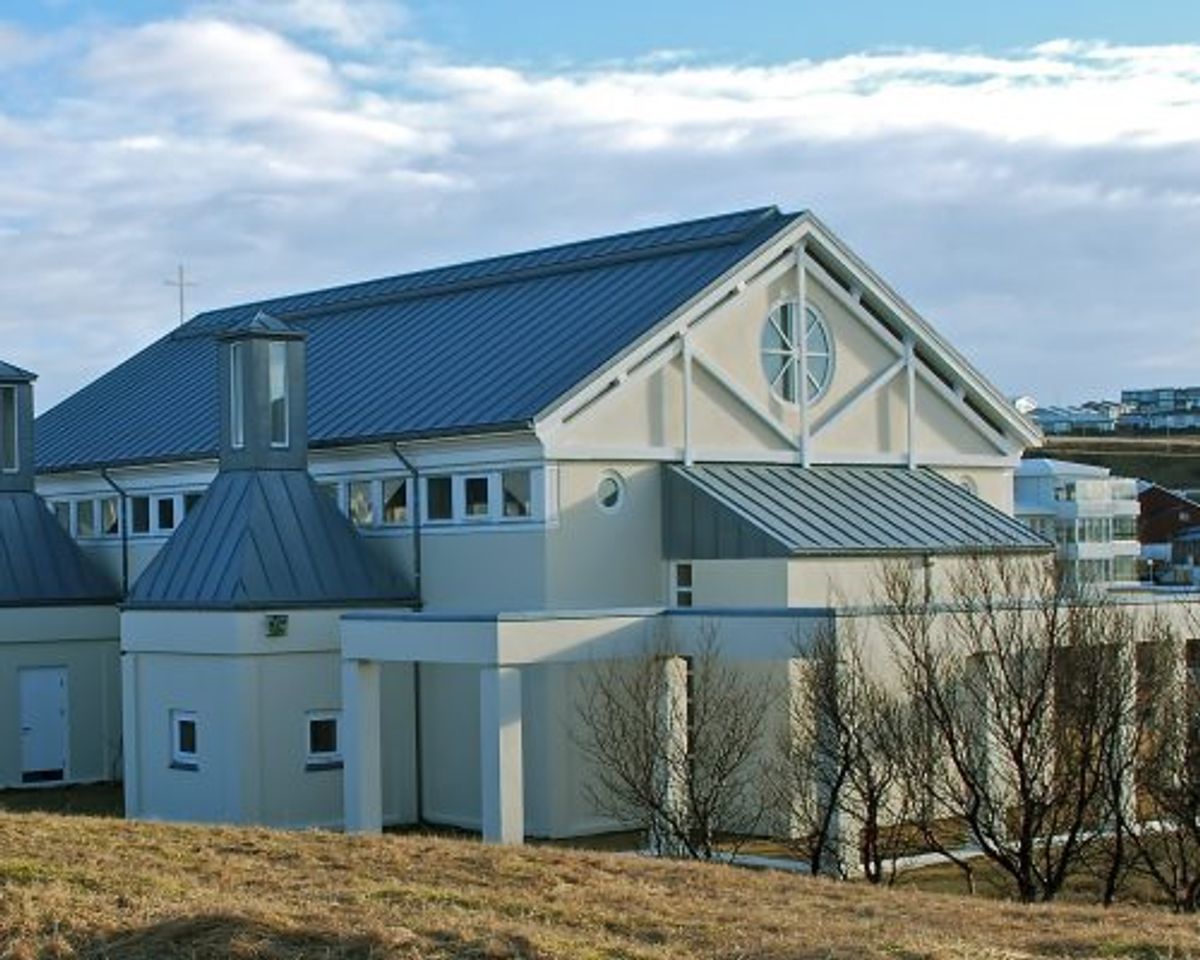
Sankti Jósefskirkja, located in the charming town of Hafnarfjörður within the Capital Region, offers a fascinating blend of historical continuity and modern architectural expression. The church, as seen in the image, is characterized by its clean, light-colored facade and a distinctive, steeply pitched blue-grey metal roof that reflects the clear Icelandic sky. A prominent feature is the large, circular window adorning the main gable, framed by elegant white cross-beams, adding a unique geometric touch to its design. Smaller, rectangular windows line the sides, allowing natural light to illuminate the interior. The story of Sankti Jósefskirkja dates back to 1925 when the Sisters of St. Joseph established a hospital and a chapel, which served the local parish. After the sale of the original buildings in the late 1980s, a new church was commissioned. Designed by architect Knútur Jeppesen, the current St. Joseph's Church was consecrated on July 3, 1993, by Bishop Alfreð Jolson. Inside, visitors can admire the 'Stations of the Cross' installed in 1997, created by the Swiss artist Bradi Barth, offering a profound artistic and spiritual experience. The church complex also includes an attached rectory and a parish hall, fostering a vibrant community hub. Its serene setting, with sparse trees in the foreground and distant residential buildings, provides a peaceful retreat for reflection and appreciation of its unique design.
Folklore
Story & Folklore
The story of Sankti Jósefskirkja begins with the enduring spirit of faith in Hafnarfjörður. Originally, the Sisters of St. Joseph established a hospital and chapel here in 1925, a beacon of care and spiritual solace. This first chapel, blessed in 1926, served as the parish church for the newly founded St. Joseph’s Parish. However, by the late 1980s, circumstances necessitated a new beginning. The hospital and original chapel were sold, paving the way for a modern vision. Under the guidance of Reverend Hjalti Þorkelsson and the architectural design of Knútur Jeppesen, a striking new church emerged on Jófríðarstaðir. Its inauguration by Bishop Alfreð Jolson on July 3, 1993, marked a new chapter. Today, its distinct blue-grey roof and light facade stand proudly, a symbol of continuity and contemporary design, further enriched by the 'Stations of the Cross' installed by Swiss artist Bradi Barth in 1997, inviting quiet contemplation.
💡 Did You Know?
Did you know Sankti Jósefskirkja, designed by Knútur Jeppesen, features unique 'Stations of the Cross' artworks installed in 1997 by Swiss artist Bradi Barth?
Culture
Stories & Legends
Icelandic sagas and folklore from this area
Explore
Hidden Gems Nearby
✦ Bradi Barth's Stations of the Cross
Inside Sankti Jósefskirkja, you'll find a profound series of 'Stations of the Cross' artworks created by Swiss artist Bradi Barth and installed in 1997. These pieces offer a unique artistic interpretation of a sacred journey.
They provide a moving spiritual experience and showcase international artistic collaboration within an Icelandic setting.
✦ Architectural Details
Take a moment to appreciate the church's modern design by Knútur Jeppesen, particularly the striking circular window in the main gable and the distinctive blue-grey metal roof. These elements give the church its contemporary character.
The architecture itself is a highlight, blending modern aesthetics with traditional church functions.
✦ Tranquil Surroundings
The church is set amidst a peaceful landscape, with a gentle slope and sparse vegetation, offering a serene environment for contemplation. Enjoy the quiet atmosphere away from the bustling town center.
It's an ideal spot for quiet reflection and to enjoy a moment of peace in Hafnarfjörður.
Help
Frequently Asked Questions
Location
📍 Location
Discover
Explore Nearby
Places from our database within 1.0 km — all data from Sanity
Loading nearby places…
0 places found within 1.0 km
Plan full itinerary →Explore More