Eiríksstaðir – Birthplace of Leif Erikson
Reconstructed Viking Age farm in Dalir associated with Erik the Red and Leif Erikson.
About
About Eiríksstaðir – Birthplace of Leif Erikson
Reconstructed Viking Age farm in Dalir associated with Erik the Red and Leif Erikson.
Walk through a reconstructed turf longhouse and explore the Icelandic home landscape associated with Erik the Red and Leif Erikson.
Photos
Photo Gallery
Background
History & Background
Eiríksstaðir, located in Haukadalur Valley, Dalasýsla, West Iceland, holds immense historical significance as the ancestral farm of Eiríkur rauði, better known as Erik the Red, the founder of the first Norse settlements in Greenland. Even more notably, it is the birthplace of his son, Leif Erikson, arguably one of the most famous figures in Norse history. Leif is celebrated for his daring voyages across the North Atlantic, culminating in his discovery of 'Vinland' – widely believed to be North America – around the year 1000 AD. This predates Columbus's arrival by half a millennium, marking a crucial, although often overlooked, chapter in the history of transatlantic exploration. The site today preserves the memory of these legendary figures. While the original structures have long since succumbed to time and elements, archaeological excavations have uncovered the foundations of Erik the Red's farm. These original foundations are now protected and visible to visitors, offering a tangible link to the past. To provide a more vivid experience of Viking Age life, a meticulously reconstructed turf longhouse stands on the site. This replica, designed to reflect the architectural style and materials of the era, allows visitors to step into the kind of home where Erik the Red and Leif Erikson would have lived. During the summer, the presence of costumed guides further enhances this historical immersion, bringing the daily routines and crafts of the Viking Age to life.
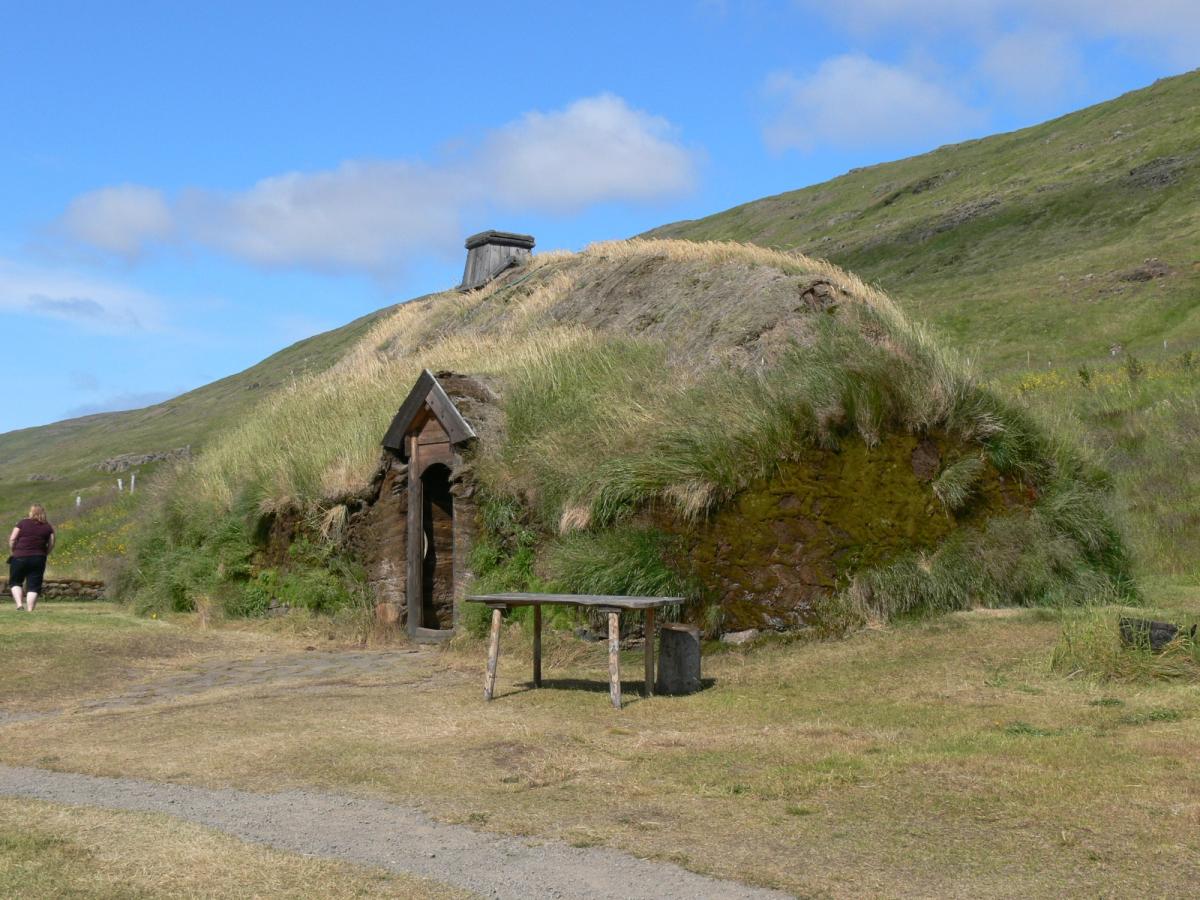
Nestled in the picturesque Haukadalur Valley, Dalasýsla, in West Iceland, Eiríksstaðir is a profound historical site, renowned as the original farm of Eiríkur rauði (Erik the Red) and, more significantly, the birthplace of his son, Leif Erikson. Leif, the intrepid Norse explorer, is widely credited with reaching North America around 1000 AD, a remarkable five centuries before Christopher Columbus. The site offers visitors a unique opportunity to connect with this extraordinary chapter of human exploration. The most striking feature is the beautifully reconstructed Viking longhouse, its turf roof blending seamlessly into the grassy hillside, as seen in the image. Its rustic wooden entrance, topped with a small gable, invites you into a world of ancient sagas. Adjacent to the entrance, a simple wooden table with sturdy wooden legs provides a place for contemplation amidst the historical setting, while a person can be seen walking nearby on the grassy grounds. During the summer months, the site truly comes alive with costumed guides demonstrating various Viking Age crafts, daily routines, and storytelling, offering an immersive and educational experience for all ages. Beyond the reconstruction, the original building foundations of Erik the Red's farm are preserved and visible beneath a protective cover nearby, allowing a direct link to the actual historical footprint. The surrounding landscape, with its gentle green slopes and patches of drier grass under a bright blue sky dotted with soft white clouds, evokes the natural environment that shaped these legendary figures. Eiríksstaðir is not just a collection of buildings; it's a window into the lives of the Norse settlers, a place where history feels tangible and the spirit of exploration still resonates.
Folklore
Story & Folklore
Imagine the rugged landscape of the Westfjords, where the winds whisper tales of ancient voyagers. Here, at Eiríksstaðir, stands a testament to a pivotal moment in history: the birthplace of Leif Erikson. As you approach the site along the gravel path, the turf-covered longhouse emerges from the rolling green hillside, its rustic wooden facade and small chimney a humble yet powerful reminder of Viking ingenuity. This is where Erik the Red, Leif's father, established his farm, and where young Leif, destined to become the first European to set foot in North America, spent his early years. Walking the grounds, past the simple wooden table outside the house, you can almost hear the echoes of their daily lives. In the summer, the air hums with activity as costumed guides recreate the crafts and routines of the Viking Age, transforming this historical site into a living museum. It's a journey back a thousand years, connecting you directly to the sagas and the spirit of exploration that defined these legendary seafarers, all under a vast blue sky.
💡 Did You Know?
Did you know that in summer, costumed guides bring the reconstructed longhouse to life, demonstrating Viking crafts and daily routines, offering a truly immersive experience?
Culture
Stories & Legends
Icelandic sagas and folklore from this area
Eiríksstaðir
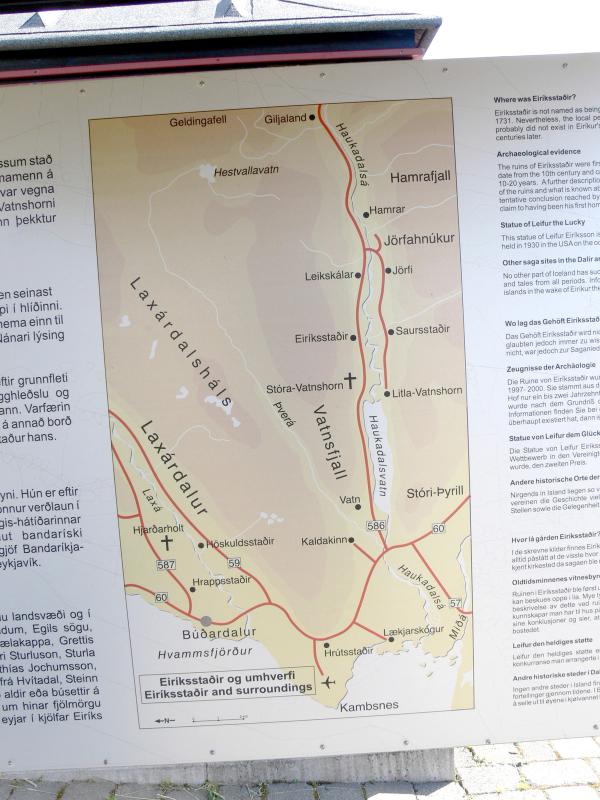
Eiríksstaðir is a historic location in Iceland mentioned in "Eiríks saga rauða", one of the ancient Íslendingasögur (Sagas of Icelanders). These medieval narratives preserve the history of Iceland's Viking Age settlement.
Leikskálar
Leikskálar is a historic location in Iceland mentioned in "Eiríks saga rauða", one of the ancient Íslendingasögur (Sagas of Icelanders). These medieval narratives preserve the history of Iceland's Viking Age settlement.
Stóra-Vatnshorn
Stóra-Vatnshorn is a historic location in Iceland mentioned in "Eiríks saga rauða", one of the ancient Íslendingasögur (Sagas of Icelanders). These medieval narratives preserve the history of Iceland's Viking Age settlement.
Explore
Hidden Gems Nearby
✦ Original Building Foundations
Beneath a protective cover, you can see the actual archaeological remains of Erik the Red's farm. These humble stones are a direct, tangible link to the legendary figures who once lived here.
It's a rare chance to stand on the exact spot where history unfolded.
✦ Viking Age Demonstrations
During the summer, costumed guides bring the longhouse to life, showcasing traditional crafts, cooking, and daily routines of the Viking Age. It's an immersive and interactive way to learn.
Offers a dynamic, living history experience beyond static exhibits.
✦ Panoramic Hillside Views
Take a moment to walk up the grassy hillside behind the longhouse for stunning views of the surrounding valley and the distant fjord. The same vistas inspired Viking settlers.
Provides a sense of the vastness and beauty of the landscape that shaped these explorers.
Help
Frequently Asked Questions
Location
📍 Location
Discover
Explore Nearby
Places from our database within 1.0 km — all data from Sanity
Loading nearby places…
0 places found within 1.0 km
Plan full itinerary →Explore More